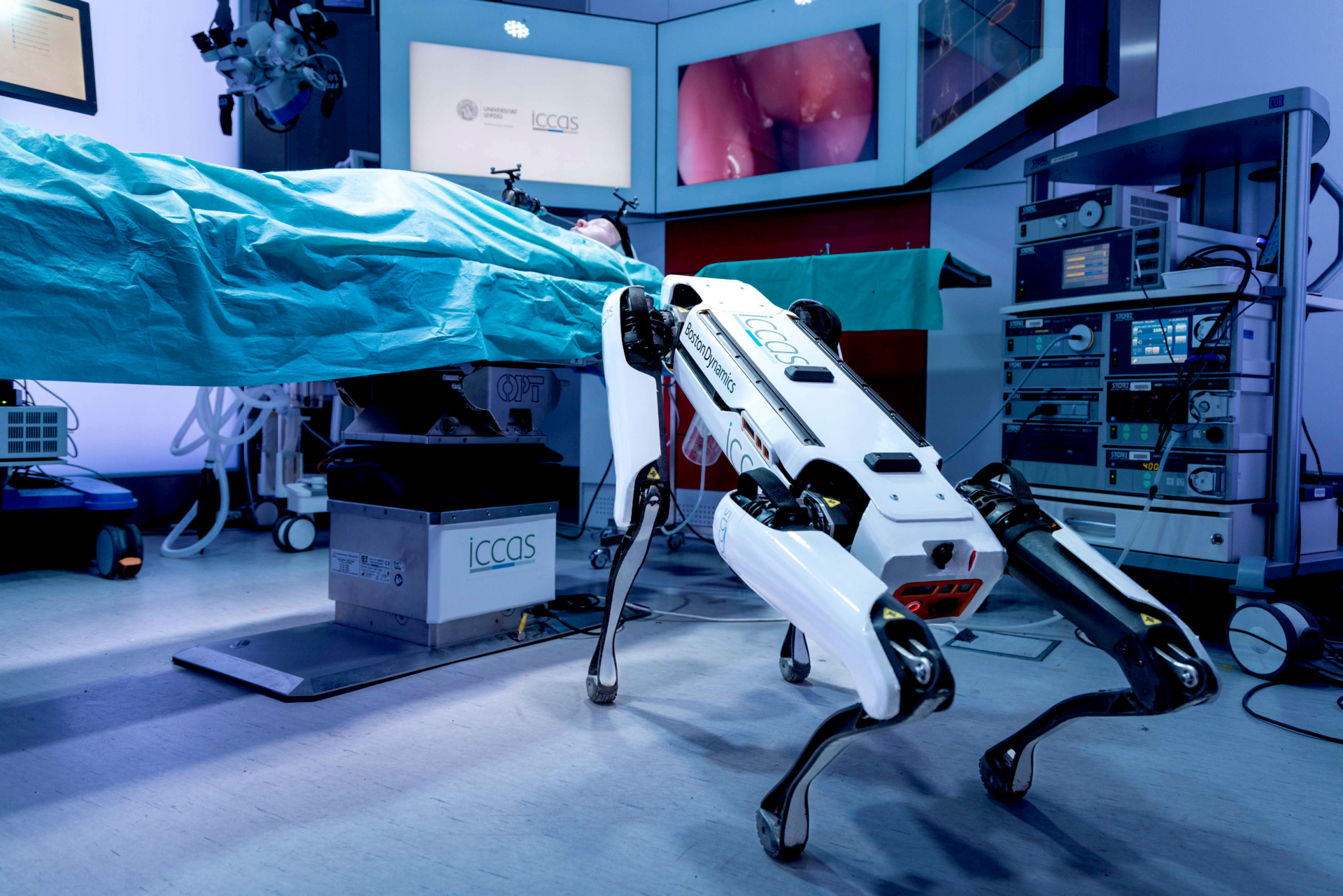
University Hospital Leipzig partnered with Apple to hold its first workshop on spatial computing for neurosurgeons in November 2024. The course offered insights into and hands-on practice with this latest technology.
1. September 2026 • News
1. September 2026 • News
Where is the field of smart medical robotics headed? In Leipzig, the answer can be found at the intersection of AI, spatial computing, medical technology, clinical validation, and techno-logy transfer. Support is readily available to companies here, thanks to a comprehensive ecosystem of funding agencies, networking platforms, and investors. The goal: to quickly turn innovative research ideas into market-ready navigation, robotics, and assistance systems.
Leipzig is home to a range of successful robotics companies
“One hurdle that smart medical robotics companies need to clear is clinical validation,” says Dr. Ronny Grunert of next3D. The University of Leipzig/Fraunhofer IWU spin-off specializes in mixed-reality navigation, instrument tracking, and customized 3D models. “We benefit from the fact that we are operating directly within the clinical environment – which allows us to rapidly transfer research findings into products and services for patient use,” says Dr. Grunert. The Leipzig-based company PHACON also uses cutting-edge technologies such as augmented, virtual, and mixed reality. The winner of the FutureSax competition develops 3D anatomical models so that surgeons can train for and plan procedures under realistic conditions.
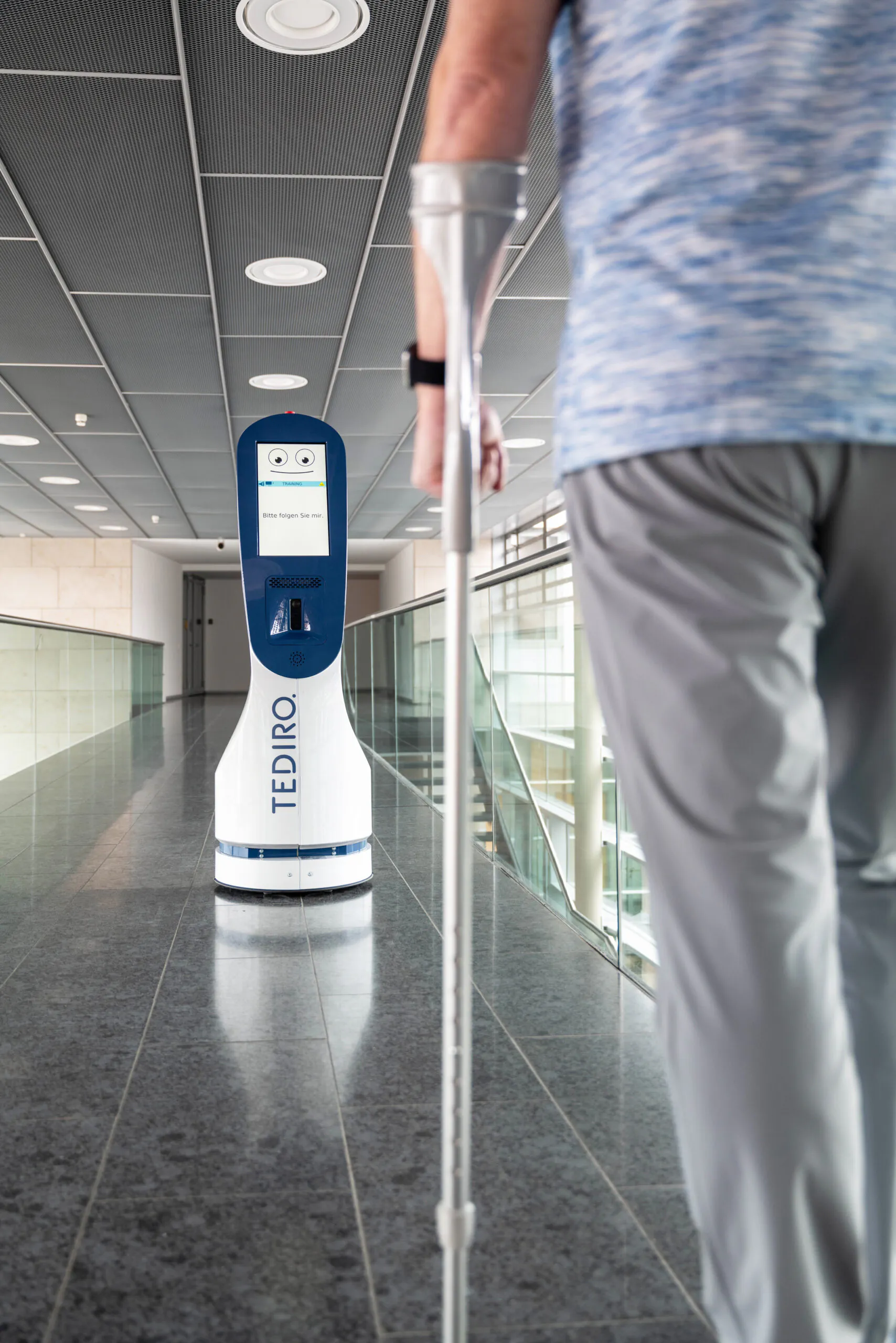
TEDIRO Healthcare Robotics, based in Leipzig/Ilmenau, has developed the THERY robot platform in collaboration with physical therapists. The mobile robot assistant accompanies and supports orthopedic patients while they walk, tracks movement patterns for therapeutic correction, provides feedback, and documents training progress. “With the support of the Saxony Technology Start-up Fund, we received seven-figure funding for THERY in 2024,” says TEDIRO CEO and co-founder Anke Mayfarth. “Our AI-powered system has CE accreditation in accordance with the MDR and can be sold throughout Europe, although we are currently focusing on the German market and developing further applications for the robot.”
A strong network of research and technology transfer partners
These success stories are made possible by a strong network of research and technology transfer partners. At the Innovation Center Computer Assisted Surgery (ICCAS) of the Faculty of Medicine in Leipzig, research is conducted at the intersection of medicine, computer science, and engineering. Among other things, the center is developing interope-rable systems and integrating robots into image-guided surgeries. Robotics companies can also find support for industrial implementation at the Saxon Fraunhofer IWU. It combines production engineering, digitalization, additive manufacturing, and spatial computing with medical applications. As the organizer of the first European Spatial Computing Healthcare Summit in June 2026, the institute was able to bring global medtech innovators like Apple to Leipzig.
A network of more than 250 experts is supporting the ScaDS.AI Leipzig, which uses a supercomputer to provide high-performance AI, computer vision, and data analysis. The transfer and service center provides consulting and training, as well as implementing pilot projects with industry partners. The new MITCenter at Leipzig University Medical Center will also be supporting companies soon – from validating their ideas, through regulatory matters and partner matching, to clinical application and market access.
Innovations: close proximity to end users helps minimize risk
Through the ICCAS, the University of Leipzig is also involved in groundbreaking robotics research. In collaboration with the HTWK Leipzig, the “SoKoRoMed” project is developing flexible and customized robotic tools. The Center for Robot-Assisted and Navigated Surgery (ZRNC) at Leipzig University Hospital offers a robust environment for clinical development and validation. Here, companies can refine their ideas with users, integrate those innovations into workflows, test them under real-world conditions, and establish them as industry standards. The benefit: Close proximity to the end user enables rapid feedback, allowing potential risks to be identified earlier.
Streamlining processes to quickly turn new ideas into market-ready products
In addition to this growing ecosystem, innovators will find a well-established life sciences cluster in Leipzig: The BioCity Campus offers flexible lab and office space as well as easy access to potential collaborators and research institutions. Conferences held in Leipzig, such as the OTWorld, ensure that the industry has global visibility. In order to develop scalable products, medical robotics needs data, engineering, clinical know-how, and regulatory expertise. Leipzig brings all these elements together and streamlines processes for compa-nies of all sizes – so that they can quickly turn their innovative ideas into market-ready products.

University Hospital Leipzig partnered with Apple to hold its first workshop on spatial computing for neurosurgeons in November 2024. The course offered insights into and hands-on practice with this latest technology.

cell-immune-gene-therapies
Small glas bottle which is normally used to store vaccine
Chimeric Antigen Receptor T Cell Therapy (CAR-T): Genetically programmed immune cell binds to and destroys cancer cell / Therapy is now available for the majority of indications
digital-health
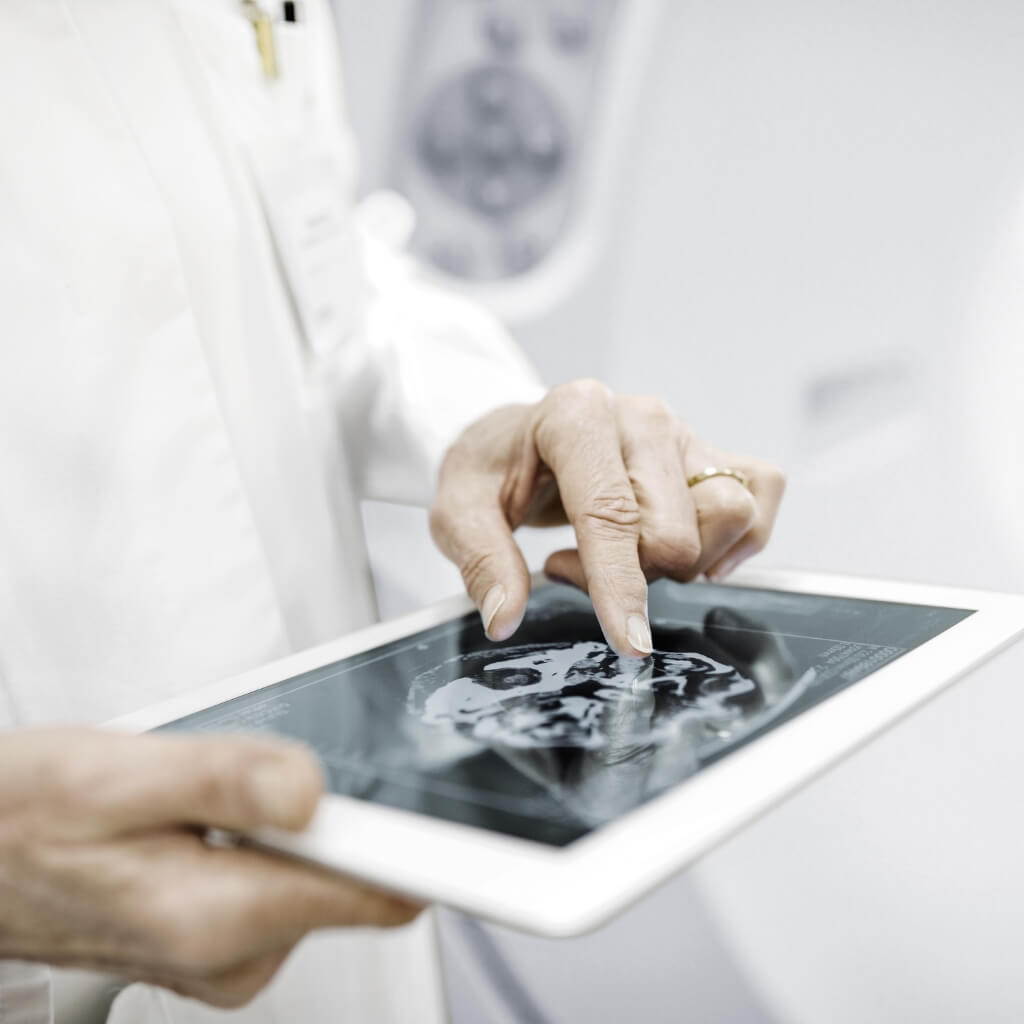
Human who looks onto a recording of brainwaves on his tablet computer and moves the model with his fingers
The Smart Infrastructure Hub Leipzig will receive a further 1,9 million euros from the cluster funding of the Saxon Ministry of Economic Affairs.
cell-immune-gene-therapies
Small glas bottle which is normally used to store vaccine
A relatively small metropolis in Germany’s Free State of Saxony – a dynamic hub for the life science industry? What was just a vision 20 years ago has become a reality for the city of Leipzig, which from October 24-26 co-hosted BIO-Europe, Europe’s largest annual biotech partnering event.