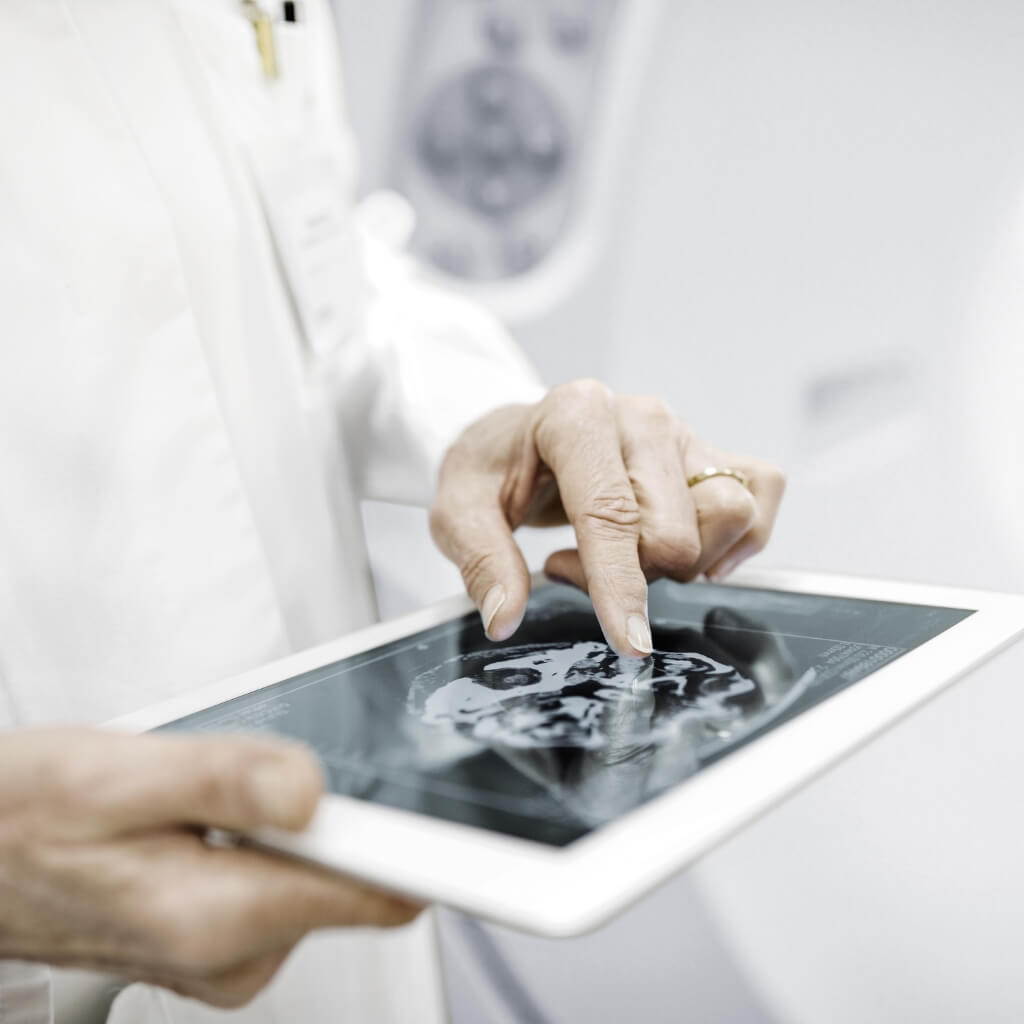
University Hospital Leipzig partnered with Apple to hold its first workshop on spatial computing for neurosurgeons in November 2024. The course offered insights into and hands-on practice with this latest technology.
30. October 2025 • News

30. October 2025 • News
Leipzig strengthens Europe’s biotech future – investors, founders, and visionaries explored new paths for growth, capital, and collaboration at Finance Day 2025
“We need more: more Europe, more investment, more confidence in the future.” – this was the shared message at this year’s Finance Day 2025, held once again at BIO CITY LEIPZIG. The event, organized by GoingPublic Media AG / Plattform Life Sciences, brought together more than 160 leaders from the European life sciences and investment communities for two days of exchange, insights, and inspiration – supported by Leipzig for LifeChangers.
From Seed to Success: Financing the Future of Life Sciences
The first day opened with a keynote by Dr. Martin Heidecker, Chief Investment Officer of the AMR Action Fund, who emphasized the importance of regional biotech clusters as breeding grounds for innovation. Successful ecosystems, he said, emerge from close collaboration between universities, research institutions, investors, and policymakers – examples being Basel, Martinsried, and Leipzig.
The event’s sessions and panels explored one central question: How can European biotech startups secure the funding they need to grow and thrive?
Dr. Angelika Vlachou from the High-Tech Gründerfonds (HTGF) outlined what early-stage investors look for: strong teams, data-driven science, and a clear vision of how innovative research translates into patient benefit. “It’s not about academic excellence alone,” she said. “Founders must show how their ideas can become real products that meet an unmet medical need.”
The Next Unicorns – and Who Funds Them
In the highly anticipated panel “The Next Unicorns – and Who Funds Them”, investors including Wellington Partners, MIG Capital, CARMA Fund, and SIVentures discussed what it takes to create billion-euro companies in Europe. While Germany currently counts 47 unicorns, most of them in Berlin, the experts agreed that valuation milestones are not the only measure of success.
Eric Weber, founder of SpinLab Leipzig, put it succinctly: “Not every startup needs unicorn potential. The typical German trade-sale exit ranges between 50 and 100 million euros.”
However, the discussion also revealed the challenges startups face: regulatory barriers, a fragmented European investment landscape, and limited access to venture capital. “It’s not about a lack of courage among investors,” said Dr. Rainer Strohmenger (Wellington Partners). “In many cases, they simply aren’t allowed to invest.”
Europe’s Momentum and the Art of the Exit
Despite the hurdles, there are positive signals. Legal reforms such as Germany’s Medizinforschungsgesetz (MFG) and the federal Hightech Agenda Deutschland aim to accelerate clinical research and strengthen biotechnology infrastructure.
Mathias Klozenbücher from FCF Fox Corporate Finance highlighted that Europe’s healthcare investment volumes are catching up – rising by 18% to almost €6.7 billion, while U.S. volumes have slightly declined. With American investors increasingly turning to Europe, he sees great potential for cross-border co-investments: “European biotech companies are capital-efficient – investors get more for their money here.”
In the final session on Exit Strategies, experts from WRS Advisory, Heuking, and Deutsche Börse discussed how startups can prepare for acquisitions or IPOs. Stefan Maassen of Deutsche Börse encouraged founders to view the stock market not as an endpoint but as a catalyst for growth: “We need a positive narrative about the capital market as a marketplace of opportunity.”
Carsten Fietz, CFO of Leipzig-based c-LEcta GmbH, shared firsthand insights from his company’s journey from startup to successful exit with the Kerry Group in 2022. His key takeaway: a convincing equity story and long-term investor relationships are crucial for success.
Networking, Innovation, and a Vision for Europe
The day concluded with a networking evening hosted by c-LEcta at its new Kerry Biotechnology Center at Alte Messe Leipzig – a perfect setting for connecting ideas and investors. On the following day, participants explored Leipzig’s innovation landscape on a tour of local institutions, including Fraunhofer IZI, ICCAS, Medical Forge Leipzig, and the BioCity Campus.
In his closing keynote, futurist Johannes Kleske reminded the audience: “The future is not a place we reach – it’s a daily decision. We create it together.”
Partners and Supporters
The organizers thank all partners who made Finance Day 2025 possible:
c-LEcta GmbH, HEUKING, Leipzig for LifeChangers, Deutsche Börse Cash Market, FCF Fox Corporate Finance GmbH, High-Tech Gründerfonds (HTGF), leap:up GmbH, WIPIT, BIO Deutschland e. V., Invest Region Leipzig, KPMG Deutschland, MIG Capital, Risk Partners, Taylor Wessing, and WTS Deutschland.
Special thanks go to Plattform Life Sciences and GoingPublic Media AG as well as to Markus Rieger, Urs Moesenfechtel, and Janina Schaipp for their outstanding organization and partnership.
Conclusion
The Finance Day 2025 once again underlined Leipzig’s role as one of Europe’s most dynamic biotech hubs. With its blend of science, capital, and community spirit, the city is helping shape the future of life sciences – for LifeChangers, from Leipzig to the world.
Photos: © OXYGEN Pictures GmbH | GoingPublic Media Ag

University Hospital Leipzig partnered with Apple to hold its first workshop on spatial computing for neurosurgeons in November 2024. The course offered insights into and hands-on practice with this latest technology.

cell-immune-gene-therapies
Small glas bottle which is normally used to store vaccine
Chimeric Antigen Receptor T Cell Therapy (CAR-T): Genetically programmed immune cell binds to and destroys cancer cell / Therapy is now available for the majority of indications
digital-health
Human who looks onto a recording of brainwaves on his tablet computer and moves the model with his fingers
The Smart Infrastructure Hub Leipzig will receive a further 1,9 million euros from the cluster funding of the Saxon Ministry of Economic Affairs.
cell-immune-gene-therapies
Small glas bottle which is normally used to store vaccine
A relatively small metropolis in Germany’s Free State of Saxony – a dynamic hub for the life science industry? What was just a vision 20 years ago has become a reality for the city of Leipzig, which from October 24-26 co-hosted BIO-Europe, Europe’s largest annual biotech partnering event.